
World Energy Perspectives | 2016
Non - tariff measures: next steps for catalysing the low - carbon economy
The World Energy Perspective 2016: ‘Non-tariff measures: next steps for catalysing the low-carbon economy’, published by the Council’s Rules of Trade Knowledge Network, includes experts from 28 countries. It explores how an open global trade and investment regime focussing on energy and environmental goods and services, can foster the transition to a low carbon economy.
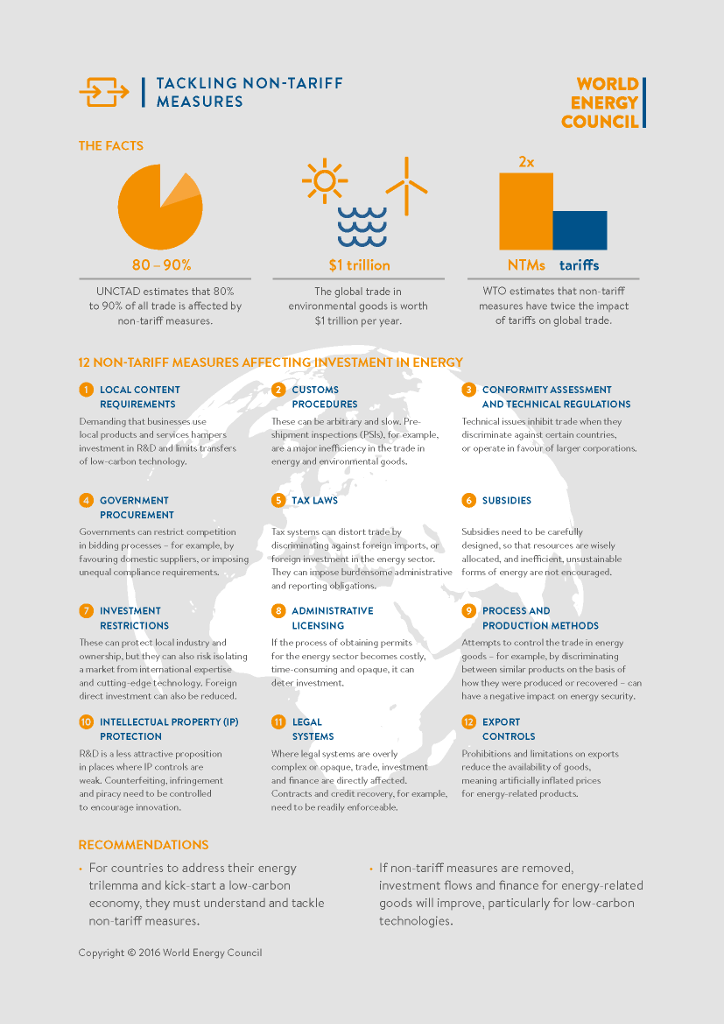
As a trade barrier, non-tariff measures (NTMs), frequently relate to customs procedures and import requirements, technical standards and other regulations that impede the flow of goods and services. NTMs affect between 80% and 90% of trade. Therefore, understanding and tackling NTMs that impact on the low-carbon energy sector should be a priority in a country’s efforts to successfully address its energy trilemma.
Tackling non-tariff measures a priority in addressing the energy trilemma
Environmental goods represent a trade market of approximately US$ 1trillion annually. Reducing barriers to trade and investment would support cost effectiveness and efficient decarbonisation of the energy sector leading to more sustainable and accessible energy systems, finds a new report by the World Energy Council.
While a number of international efforts have been progressing in the elimination of tariff barriers, a comprehensive initiative to phase out non-tariff barriers on products covered in the current multi-national environmental goods tariff negotiations could be undertaken.
These topics are only just starting to be addressed within the World Trade Organisation (WTO) rules and appear to be limited, states the report launched at the APEC Market Access Group meeting in Lima, Peru, on 18 August.
The report identifies significant NTMS directly affecting investments in the energy industry:
- Local content requirements that are not carefully structured can hamper local and foreign investments in research and development and limit low-carbon technology transfer and energy projects due to a lack of local capabilities
- Government procurement practices inhibit competition when they favour domestic suppliers and imposing burdensome administrative compliance
- Transparent and efficient application of custom procedures help to avoid arbitrary and unnecessary formalities in trading energy and environmental goods
Infographic - Non tariff measures next steps for catalysing the low carbon economy
Key recommendations:
- NTMs related to environmental goods should be addressed to enable the energy sector to transition towards decarbonisation in cost-effective and efficient manner
- Subsidies for energy technologies should be well designed or they could result in inefficient and unsustainable use of subsidised energy
- Where existing rules apply these should be enforced as needed
- Where rules do not exist WTO members should consider developing them
Rather than introducing new measures, governments could find solutions in adjusting existing measures to spur competition guarantee transparency and correct failures in the trade system such as resolving inefficiencies and discriminatory or duplicative measures.

Christoph Frei, Secretary-General of the World Energy Council – Addressing the energy trilemma presents extraordinary challenges for policymakers and requires an adequate global trade and investment regime. This would encourage and leverage investment, innovation and technology uptake, to meet the climate and energy objectives set by the United Nations, G20 and COP 21.”
A session on trade and innovation will play a central part in discussions at the 23rd World Energy Congress in October, which will see global energy leaders address the critical energy frontiers facing the global energy sector today. ‘The imperative of trade: Accelerating the innovation transfer’ is one of the Congress sessions addressing Governance frontiers. It will be led by Morlaye Bangoura, Commissioner, Energy and Moines, ECOWAS, Nigeria alongside Ricardo Melendez-Ortiz, Chief Executive Officer, International Centre for Trade and Sustainable Development (ICTSD), Switzerland and Timothy Richards, Executive Chair, Rules of Trade, World Energy Council on 12 October.
WEC Italy at work for the WEC Rules of Trade Group
An Italian Experience
Stefano Mottarelli is currently Public and EU Affairs Specialist, Edison. Stefano, who joined the WEC Rules of Trade Group in 2015, briefly summarizes his interesting working experience with experts from 28 countries on producing the new report World Energy Perspectives 2016 with a closer look at Italy. He is also a member of the Future Energy Leaders’ community and he will take part in the coming 23° World Energy Congress in October.

I’ve really enjoyed working with experts from 28 countries on producing such an impactful report, that will make a very valuable contribution to the debate on how to moderate non-tariff measures and will serve the World Energy Council well as a major player in international trade policy discussions. Reducing barriers to trade and investment would significantly support an efficient decarbonisation of the energy sector, leading to a more sustainable and accessible energy systems, while helping countries balance their energy trilemma.
As far as Italy is concern, albeit we have come quite a long way in recent years, complex administrative procedures, involving a variety of agencies and local bodies, still pose a barrier to investment in the Italian energy sector. Furthermore, the Italian judicial system has recorded long overdue and has sometimes been represented as a non-tariff barrier against foreign investments. I hope that the recent reforms put in place at national level can also contribute to break down those non-tariff barriers.”
