
World Energy Perspectives
The road to resilience: managing the risks of the energy-water-food nexus
The ‘road to resilience – managing the risks of the energy-water-food nexus’, is the second risk dimension investigated as part of the “Financing Resilient Energy Infrastructure” initiative. The first report in the series, ‘The road to resilience – managing and financing extreme weather risk’, recommended moving towards a more systemic understanding of resilience, in order to best manage extreme weather risks.
This report takes a deep-dive approach to investigate the systemic risks of the energy-water-food nexus, and examines the integrated coordination that is needed for financing resilience. The report methodology is based on contributions from experts in 92 countries. Case studies have been submitted from the energy, insurance, financial, and academic communities to highlight the impact, obstacles and solutions that countries have taken to manage the impacts of the energy-water-food nexus.
The reports are prepared with project partners Swiss Re Corporate Solutions and Marsh and McLennan Companies with insights from the European Bank for Reconstruction and Development and will build to provide a detailed report ahead of the 23rd World Energy Congress to be held in Istanbul, Turkey in October 2016.
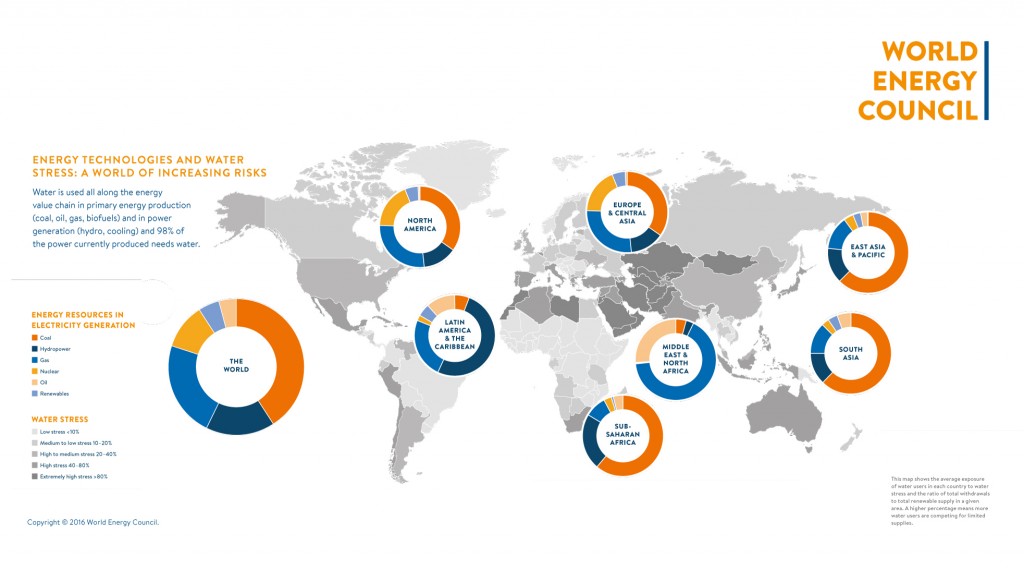
Key findings
Presented at the Asia-Pacific Energy Leaders’ Summit in New Zealand the early findings of a new report, ‘The road to resilience – managing the risks of the energy-water-food nexus’ from the World Energy Council is calling for immediate action in order to secure resilient energy infrastructure. Prepared by a task force of over 140 experts from across the world, the report makes five recommendations:
- Improve understanding of the water footprint of energy technologies in order to mitigate the risks of stranded assets
- Account for the ‘price’ of water scarcity, particularly in areas of water stress
- Consider a wider range of financial and insurance instruments to hedge short term risks such as adverse weather incidents and electricity price volatility
- Give investors the confidence to invest by providing them a full risk assessment that includes different climate and hydrological scenarios in financial analyses
- Provide a reliable and transparent regulatory and legal framework that takes into account water issues and competing stakeholders’ interest.
 Christoph Frei, Secretary General World Energy Council said: “The energy-water-food nexus poses a systemic risk which could impact the robustness of the energy supply and demand over many years to come. Power plants across the world could be affected by changes in precipitation patterns, which are combining with increasing competition between water users to adversely affect the resilience of energy services.
“Clear co-ordination and integrated planning needs to take place now, or we will start to see the effects of water scarcity on energy supplies in the very near future and assuming a water price during project planning is one way to trigger the right signals.
“If we are to counter the problems of water access, then cross-border co-operation is vital. We should be taking full advantage of the 261 international trans-boundary basins that cover 45% of the earth’s land surface. Energy resilience can only be achieved by moving from individual to joint efforts.”
