
World Energy Resources
E-storage: Shifting from cost to value - Wind and solar applications
The Knowledge Network Energy Storage, which is part of the Study Group of the flagship World Energy Resources. Like all the Council’s Networks, it includes experts from across the world, both from companies as well as academia. Companies active in the Storage Knowledge Network include DNV GL, PWC, Siemens, Iberdrola and Enel Green Power.
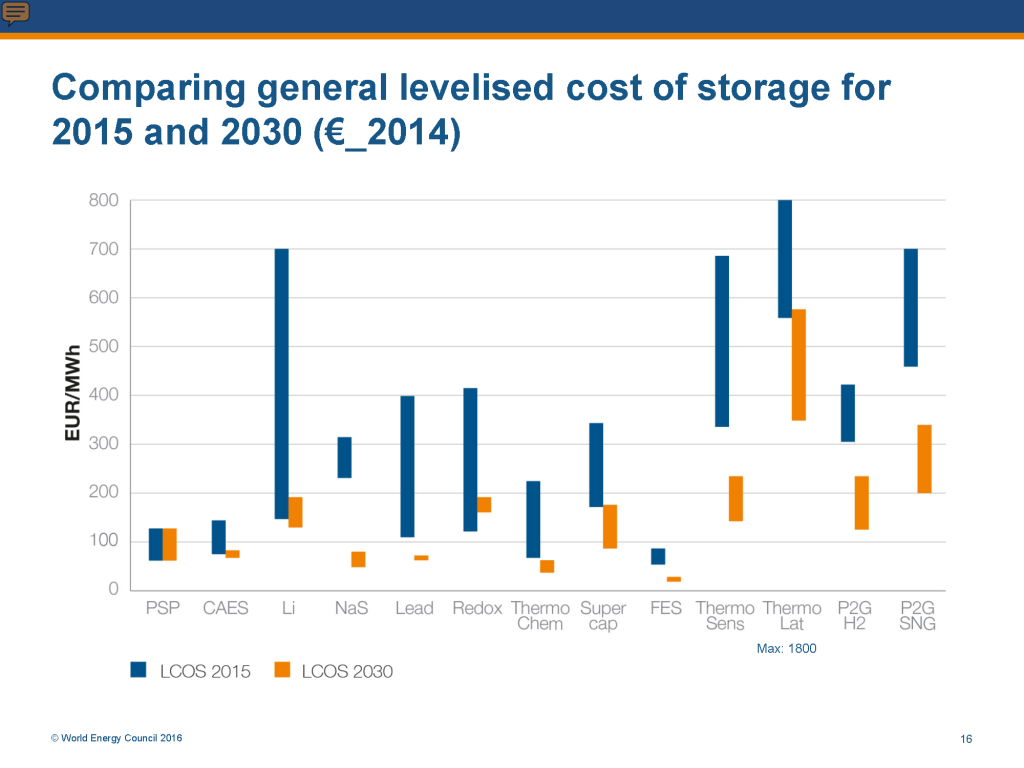
Rapid cost reductions and significant improvements in capacity and efficiency captivated the global energy sector with the promise of deploying energy storage alongside renewables. Storage is seen as a game-changer which could contribute to solving the volatility challenge of wind and solar electricity generation. Cost estimates for energy storage are available, but the costs (and value) for business models in conjunction with solar and wind need to be fully understood. The report uses recent estimates of costs, and forecasts for 2030, for ‘application cases’ specific for solar and wind.
This report seeks to interrogate what the cost base of an array of storage technologies really means; key conclusion is that a narrow focus on levelised cost alone can be misleading. Throughout the cost modelling process, the same issues repeatedly emerged, namely the importance of defining the business model under consideration and how the storage plant was being operated. Although the report focused on cost, it led to a number of insights on storage’s value. A common metric employed when comparing the cost profile of different renewable technologies is the levelised cost of energy (LCOE). In this analysis the formula has been transferred to storage technologies, as an economic exploration of the discharging side of energy storage. Because storage plant does not generate power and depends on another generating technology, the formula is referred to as the levelised cost of storage (LCOS).This report defines and models two plausible applications of storage: storage with solar, and storage with wind plant, assessing the resultant LCOS of storage plant.
Key findings:
- The costs of energy storage technologies are forecasted to reduce by as much as 70% by 2030.
- Levelised Cost of Storage (LCOS) is useful as a metric, but its limitations need to be clearly understood: in particular, it depends not only on the energy storage technology and the location (which are relevant for costs of generation technologies), but also on the application. Therefore a case by case approach is necessary.
- Since the renewables industry benefitted from policy mechanisms which de-risk its revenue streams, the tendency to have a very narrow focus on the levelised cost of storage (LCOS), is also applied to storage.
- From a country and societal perspective, the value of storage lies in the ability to provide power reliability and improve power quality, adding to security of supply. This can be in the form of uninterrupted power supply to end-users, providing some reserve margin, or initial power to restart the grid after a blackout. In this context, high reliability is more important than high costs.
- Storage creates additional value through its function to level the load, it enables deferral of grid investment, especially at congestion points and creates the possibility of price arbitrage for operators.
Key findings of costs analysis:
- Solar storage will become highly competitive if battery technology become cheaper on a large scale.
- Wind storage is very sensitive to the number of discharge cycles per year. The larger the number the number of discharge cycles per year, the larger the competitive advantage is of the wind storage application will be.
- The Levelised Cost of Storage (LCOS) is strongly affected by the application case. The report shows that the combination of PV and storage has lower costs than the combination of wind and storage, principally because the storage provides benefit on a daily cycle, rather than the longer weather-driven cycles exhibited by wind generation.
What does it show?
Understanding the value of energy storage in conjunction with solar and wind requires knowledge of the application case, and the value that may be obtained from the services that could be provided. Levelised costs, as commonly used in the renewable energy industries, is still useful, but does not provide the full story.
The wider value for energy storage is the long-term trend towards the growth of renewables (wind and solar), which creates a need for increasing flexibility for energy supply. With regards to increasing renewable energy generation, the energy sector is right to be enthusiastic for energy storage but for the wrong reasons. Instead, what increasingly matters is not so much the capital cost reduction, but the growing value of specific storage technologies in relative contexts. The revenue streams depend on the market in question; the stability of policy regimes and the availability of competing resources. Thus, it is difficult to to generalise on the international competitiveness of storage. Instead, analysing the cost competiveness of the technology should include nationally-tailored inputs that reflect the individuality of the specific market. The energy industry is well-equipped to analyse and discuss costs on an international level, but there is a need to acknowledge the value of energy storage and integrate this into traditional revenue modelling.
The World Energy Council recommends the following:
- Policymaker should take into account the costs and the value of energy storage.
- A stronger focus on the required scope of application, and less on the type and cost of technology.
- Regulators should provide guidance for usage of energy storage and market regulation, which reflects the added value of energy storage on industry balance sheets.
- New market designs should ensure that ancillary services are considered. The growth in the deployment of renewables creates new urgency for the need for more flexible markets. The development of flexible markets will help to address the revenue risk that is currently associated with the costs of storage plants.
- Flexible markets and other initiatives.
